Connected TV is one of the fastest-growing marketing channels and also one of the most confusing to buy. US CTV ad spending is tracking toward roughly $38 billion in 2026, and for the first time streaming upfront commitments ($17.73 billion) came in ahead of primetime linear ($16.98 billion). Yet when a brand asks which connected TV advertising platform to use, the names that come back — MNTN, Vibe, tvScientific, Tatari, The Trade Desk — get dropped into a single list as if they were interchangeable. They are not. Some are self-serve DSPs. One operates closer to a buying agency with direct network deals. Several never touch linear TV at all. This guide separates them, and then covers what actually moves performance once the contract is signed.
⚡ Quick Answer: Which Platform Fits Which Buyer
- MNTN — performance-driven CTV at scale, self-serve with a managed layer
- Vibe — low minimums and the fastest launch (now part of Walmart)
- tvScientific — outcome-based buying and pricing (now part of Pinterest)
- Tatari — linear and streaming bought and measured together
- MultiLocal — global curation across 190+ markets
- Swym — AI decisioning inside the DSP you already use
- Chalice AI — custom algorithms trained on your own data
- Audigent — cookieless identity and data curation
- Curated.Media — self-service PMP deal building
- Advanced Curation — fast deal IDs with no contracts or minimums
- Splash Bay Media — CTV-specific curated PMPs with shopper-intent data
These platforms are listed in no particular order and this guide does not rank them. They solve genuinely different problems, and several are complementary rather than competitive — a curation layer and a buying platform often run together. What follows is what each one is built for, so you can match a partner to your plan instead of to a leaderboard.
How These Platforms Actually Differ
Before comparing pricing or targeting, sort any CTV vendor into one of three buckets. Most bad platform decisions come from comparing companies that were never solving the same problem.
- Buy-side platforms with a managed-service layer. MNTN, Vibe and tvScientific are software first. You log in, you set an outcome, and their buyers and algorithms bid on inventory. They are streaming only. This is the right shape for a brand whose media lives in performance marketing.
- Convergent TV partners. Tatari and the small group of shops like it hold direct relationships with networks and device manufacturers, and they transact linear as well as streaming. They look like technology, but the economics come from buying power and direct integrations. This is the right shape for a brand that still has broadcast on the plan.
- Curation and supply-side decisioning. MultiLocal, Swym, Chalice, Audigent, Curated.Media, Advanced Curation and Splash Bay Media do not replace your DSP. They shape what your DSP is allowed to buy — packaging inventory into deal IDs, filtering supply pre-bid, layering data, and cutting out intermediary margin. This is the fastest-growing part of the CTV stack and the least understood.
One practical note on search: buyers looking for streaming-only execution tend to search for connected TV providers or CTV platforms. Buyers who need broadcast and streaming under one roof search for a TV agency or an all-in agency for TV buying. Those are two different shortlists, and vendors that rank for one frequently cannot service the other.
MNTN — Performance-Driven CTV at Scale

Where it fits: Growth and enterprise brands that want TV judged on the same metrics as search and social.
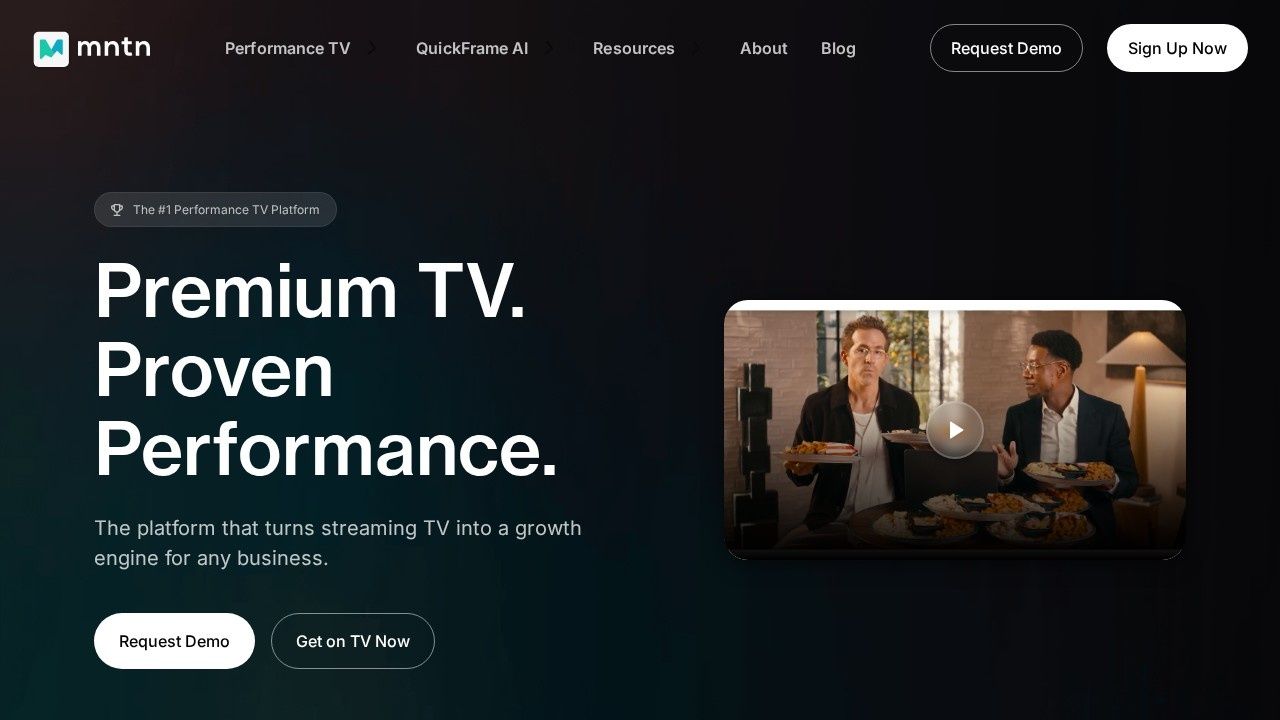
MNTN built its business on a single argument: television should be bought like a direct-response channel, not an awareness channel. Its Performance TV platform buys across 150+ streaming networks — Paramount+, Peacock, NBC and CBS among them, plus live sports inventory from the NFL, NHL and MLB — and reports back on site traffic, conversions and ROAS instead of gross rating points. The company says its system evaluates more than a trillion behavioral signals a day and makes over four million bid decisions a second, and it credits its Matched Audiences with 7x more site traffic, 2.4x higher ROAS and half the CPA of standard segments.
The practical appeal for a buyer is the on-ramp. There is no minimum commitment, campaigns can be live in under an hour, and QuickFrame AI will assemble a TV-ready spot out of your existing website and product assets — which removes the single most common reason mid-market brands never launch on CTV, which is that they do not have a commercial. What MNTN does not do is linear. If your plan requires one partner to buy broadcast and streaming together, this is not that partner.
- Official Website: mountain.com ↗
- Model: Self-serve platform with managed-service support
- Inventory: 150+ streaming networks, including premium live sports
- Linear TV: No — streaming only
- Minimums: No minimum commitment; enterprise tier for $100K+ annual spend
- Notable clients: Leesa, Cisco, TaskRabbit, Morgan & Morgan
Vibe — Low-Minimum Self-Serve Streaming

Where it fits: SMBs, DTC brands and agencies that want to test streaming TV for a few hundred dollars rather than a few hundred thousand.
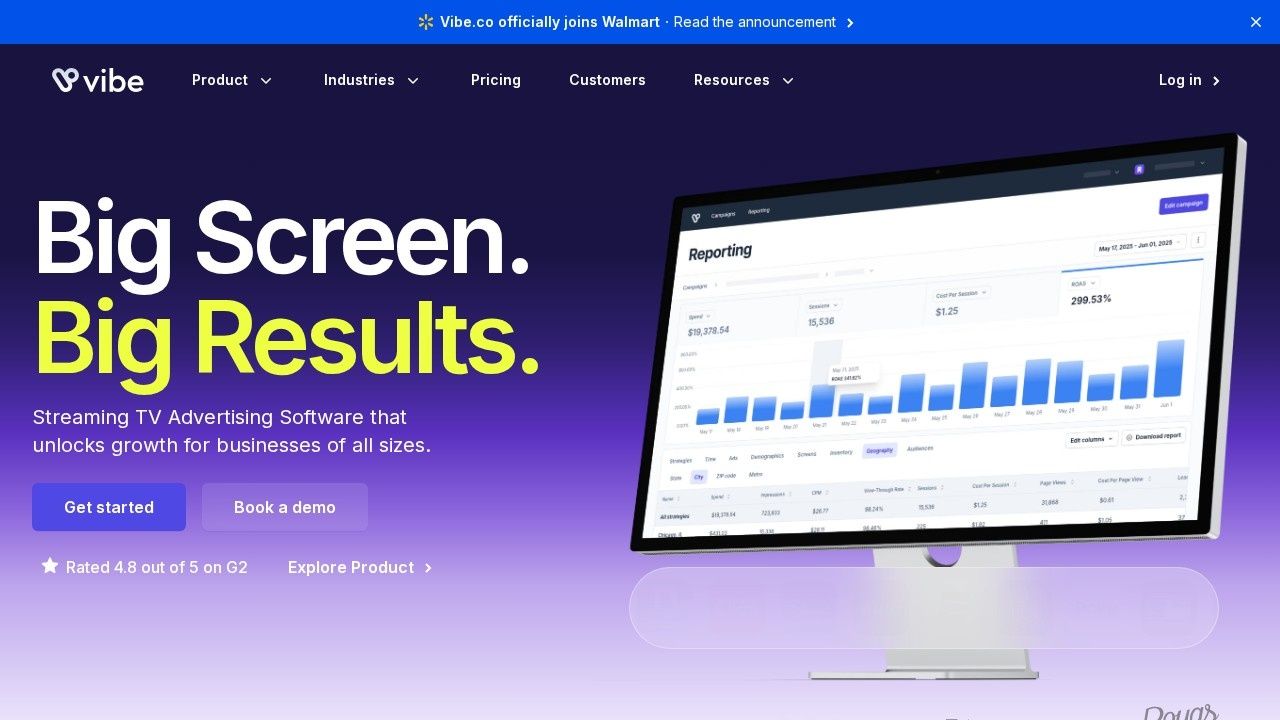
Vibe is the lowest barrier to entry in connected TV. Campaigns start at $500, launch in about five minutes, and run across 500+ premium channels including Disney+, Hulu, ESPN, Netflix, Roku, Peacock and Tubi. It plugs into Klaviyo, Shopify and Google Analytics, which is why it has become the default first CTV buy for e-commerce brands already living in that stack, and Vibe Studio will generate the creative for advertisers who arrive without a spot.
The bigger development is ownership. Walmart announced its acquisition of Vibe in June 2026 and completed it on August 4, 2026, folding the platform into Walmart Connect. The logic is retail-media convergence: Walmart has enormous first-party shopper data and limited streaming distribution, while Vibe brings self-serve distribution to more than 10,000 advertisers. For buyers, the thing to watch is the integration — a Vibe campaign wired directly into Walmart purchase data would be a materially different product from what exists today. Like MNTN, Vibe does not offer linear.
- Official Website: vibe.co ↗
- Model: Self-serve platform, optional account management
- Entry point: From $500; campaigns live in roughly five minutes
- Inventory: 500+ streaming channels
- Linear TV: No — streaming only
- Ownership: Acquired by Walmart; deal completed August 4, 2026
tvScientific — Outcome-Based CTV Buying

Where it fits: Performance marketers in apps, e-commerce, fintech, insurance and travel who want to buy TV against a cost-per-outcome.
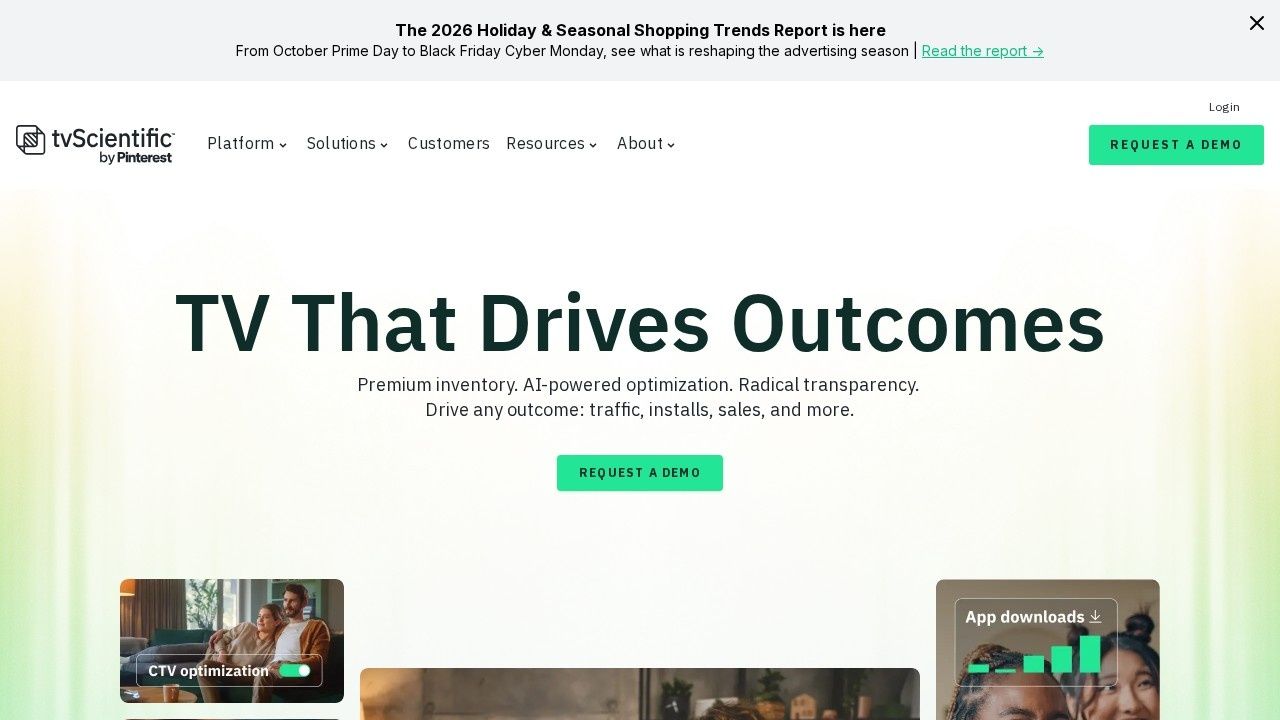
tvScientific’s pitch is that you should pay for results rather than impressions. The platform optimizes toward installs, sales and conversions, publishes real-time campaign reporting it describes as radical transparency, and deliberately mirrors the control surface of paid search and social so a performance team does not have to learn a new discipline to run television. Its client list includes EA Sports, Crocs, WeightWatchers, Foot Locker and the NBA.
In December 2025 Pinterest agreed to acquire the company, and the platform now carries tvScientific by Pinterest branding. The strategic read is the same one behind the Walmart–Vibe deal: businesses with deep intent data and no television distribution are buying television distribution. Advertisers already spending on Pinterest should expect the two environments to couple more tightly over the next few planning cycles. Like the rest of this tier, tvScientific is streaming only.
- Official Website: tvscientific.com ↗
- Model: Self-serve platform with performance-based pricing
- Optimizes toward: Installs, sales, sign-ups and other business outcomes
- Linear TV: No — streaming only
- Ownership: Acquired by Pinterest (announced December 2025)
- Notable clients: EA Sports, Crocs, WeightWatchers, Foot Locker, NBA
Tatari — Linear and Streaming in One Place

Where it fits: Brands and agencies that need broadcast, streaming and online video bought and measured against a single plan.
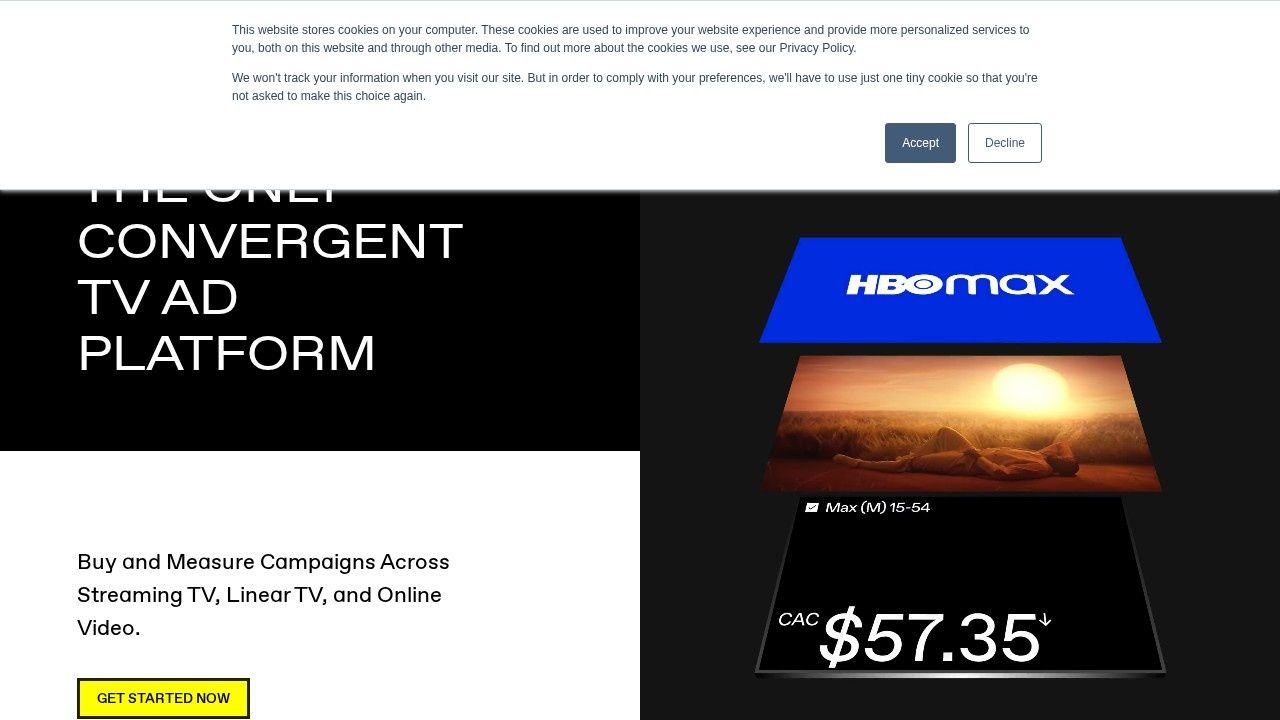
Tatari is the structural outlier on this list, and understanding why is useful even if you never buy from them. Where most platforms here are a DSP with a services layer attached, Tatari operates closer to a buying agency with technology underneath. It transacts across streaming TV, linear TV and online video, holds direct relationships with networks and device manufacturers rather than relying purely on open-market bidding, and pairs its own measurement stack with a programmatic DSP for buyers who prefer to self-serve. It works with first-time TV advertisers and with brands spending $100 million a year, including Vuori, Calm and Fiverr.
That convergent footprint is why it wins accounts the streaming-only platforms lose. Large advertisers with existing broadcast commitments generally do not want two vendors, two measurement models and two sets of reach curves — a seven-figure monthly account will walk away from an excellent streaming platform for exactly this reason. If linear is on your plan, Tatari and the handful of shops built like it are your shortlist. If it is not, you are paying for capability you will never use.
- Official Website: tatari.tv ↗
- Model: Convergent TV platform with optional strategy and managed services
- Channels: Streaming TV, linear TV and online video
- Differentiator: Direct network and device-manufacturer relationships plus a programmatic DSP
- Fit: First-time TV advertisers through $100M+ annual spenders
- Notable clients: Vuori, Calm, Fiverr
The Curation Layer: Where CTV Efficiency Is Actually Won in 2026
The next seven companies are not alternatives to the four above. They sit between your DSP and the supply, deciding what your money is allowed to buy before the bid is placed. Two forces created this category. First, the CTV supply chain is fragmented enough that identical inventory can reach a buyer through four different paths at four different prices. Second, advertisers have started going direct to device manufacturers and publishers rather than paying a chain of intermediaries — better cost control, at the price of doing more of the thinking yourself. Curation is how buyers get the cost control without rebuilding an agency in-house.
MultiLocal — Global Curation Across 190+ Markets

Where it fits: Advertisers and agencies running CTV and video across multiple countries who need local supply expertise at scale.

MultiLocal is a curation company rather than a DSP. Founded in 2019 by former Microsoft executives, it sits between buyers and media owners and assembles the supply itself. Its Curation Intelligence Platform draws on a proprietary database of 35,000+ domains and 62,000 audience data points, and its Active Curation approach keeps adjusting the deal after a campaign is live instead of treating curation as a one-time setup step. The company operates across 190+ countries with more than 100 curation specialists — the reason to call them is usually geography.
Reported outcomes include 20–40% campaign performance improvement, a 38% increase in video completion rates and a 40–60% reduction in campaign carbon footprint; on the sell side it claims a 24–28% yield lift for media owners. It is independently owned, which matters more in curation than in most categories: a curator attached to an SSP has a structural reason to route you toward its own supply.
- Official Website: multilocal.media ↗
- Model: Managed curation service, platform-agnostic across SSPs, DSPs and DMPs
- Coverage: 190+ countries; 100+ curation specialists
- Data assets: 35,000+ domains, 62,000 audience data points, Media Quality Index
- Ownership: Independent
Swym — AI Decisioning Inside Your Existing DSP
Where it fits: Buyers who do not want to change DSPs but want to stop paying for impressions that were never going to perform.
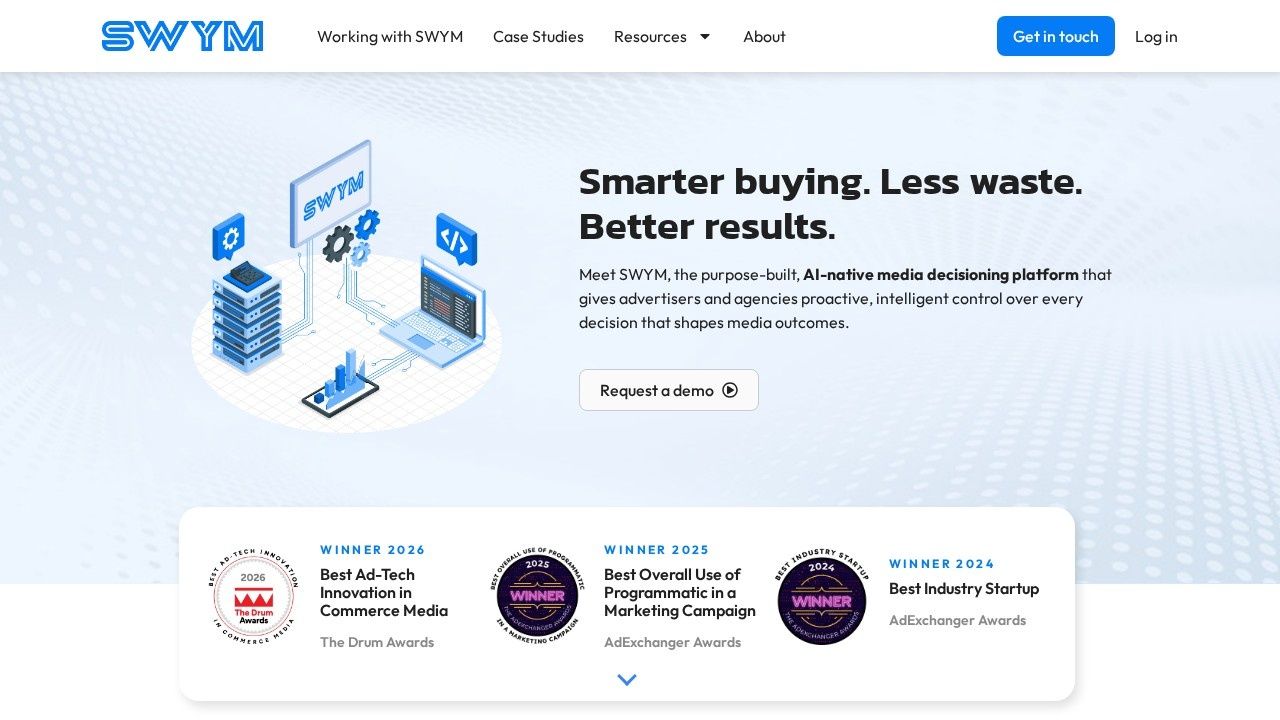
Swym is an AI-native media decisioning layer that operates in the transaction itself rather than in post-campaign reporting. It filters inventory before the bid, removes fraudulent and chronically low-performing placements pre-emptively, and activates inside your existing DSP as a private marketplace — so adopting it does not mean rebuilding your buying stack. The company frames the problem as the programmatic supply paradox: the market is full of lemons priced like cherries, and optimizing after the fact only tells you what you already wasted.
Reported results are 20%+ improvement in primary KPIs alongside reductions in wasted spend and cost per acquisition, and the company has picked up AdExchanger recognition as Best Industry Startup (2024) and for Best Programmatic Campaign Use (2025). One caution that applies to this whole tier: heavily curated supply often carries a higher headline CPM than open-market buying, so the business case has to be made on net efficiency, not on the rate card.
- Official Website: swym.ai ↗
- Model: AI decisioning layer activated as a PMP inside your DSP
- Core mechanic: Pre-bid inventory filtering and automated deal optimization
- Reported lift: 20%+ on primary KPIs
- Recognition: AdExchanger Best Industry Startup (2024), Best Programmatic Campaign Use (2025)
Chalice AI — Custom Algorithms You Own

Where it fits: Sophisticated advertisers and agencies that want a bidding model trained on their own data instead of a vendor’s black box.
Chalice sells the idea in its tagline — AI that’s yours. Rather than asking you to adopt another platform’s optimization logic, it builds algorithms that run inside the ad platforms you already use. CurateAI folds contextual targeting, quality scoring and dynamic pricing into a single model tuned to one KPI you choose. AI Audiences extends reach into Meta, YouTube and other social environments. For advertisers with enough scale to justify it, Chalice will build a fully bespoke model trained on your data and your measurement approach, with hands-on support.
Published case-study results include a 1.5-point lift in incremental sell-through, a 6% increase in new-to-brand sales and a 28% reduction in CPA. The reason experienced buyers gravitate here is ownership of the logic: when a black-box algorithm underperforms, you have no lever to pull except the account manager. When the model is yours, you can interrogate it.
- Official Website: chalice.ai ↗
- Model: Platform-independent custom algorithms activated in your existing DSPs
- Products: CurateAI, AI Audiences, fully custom AI models
- Reported results: +6% new-to-brand sales, 28% CPA reduction, 1.5pt sell-through lift
- Best paired with: Advertisers with clean first-party data and a defined KPI
Audigent — Data Curation and Identity

Where it fits: Advertisers who need privacy-safe addressability without cookies, and publishers monetizing first-party data.

Audigent is a data activation, curation and identity platform, now part of Experian. Its Hadron ID is a cookieless identifier built on a five-point identity framework, and its SmartPMP, ContextualPMP and CognitivePMP products package that data into buyable deals across more than 20 SSPs. The scale numbers are the pitch: 4+ billion first-party IDs, 1.8+ billion monthly traffic events, and over 100,000 campaigns a month, with publisher partners including Condé Nast, Warner Music Group and Fandom.
The specific detail buyers should press on is pricing transparency — Audigent markets its PMPs as transparently priced without bid shading, which is not the default in this market. Being inside Experian also puts identity and offline data resolution under the same roof as the supply, which is exactly the combination most advertisers are trying to assemble by hand.
- Official Website: audigent.com ↗
- Model: Data activation, curation and identity; curated PMPs across 20+ SSPs
- Identity: Hadron ID cookieless identifier
- Scale: 4B+ first-party IDs; 100,000+ campaigns monthly
- Ownership: Part of Experian
Curated.Media — Self-Service PMP Deal Building

Where it fits: In-house teams and agencies that want to build and control their own deals rather than accept a vendor’s packages.

Curated.Media positions itself as the leading independent self-service curation platform. Buyers assemble PMP deals themselves — starting from pre-built packages or building custom ones — generate the deal in seconds and activate within minutes, with no code involved. Inventory can be layered with publisher first-party data and third-party audiences, and CTV packages can be cut contextually or by genre. It spans display and native, video and audio, DOOH, CTV and YouTube.
The company’s Supply Side Trader framing is the point of difference: it is built for buyers who want direct supply-side control rather than a managed intermediary, and it serves publishers looking to capture margin directly as well as agencies trying to cut waste out of the path. If your team has the appetite to own curation as a discipline, this is the toolset.
- Official Website: curated.media ↗
- Model: Independent self-service curation platform
- Channels: CTV, video and audio, display and native, DOOH, YouTube
- Speed: Deals generated in seconds, campaigns activated in minutes
- Serves: Agencies, direct advertisers, publishers and ad tech platforms
Advanced Curation — Fast, No-Commitment Deal IDs

Where it fits: Media buyers juggling multiple SSP relationships who want deal creation consolidated behind one login.
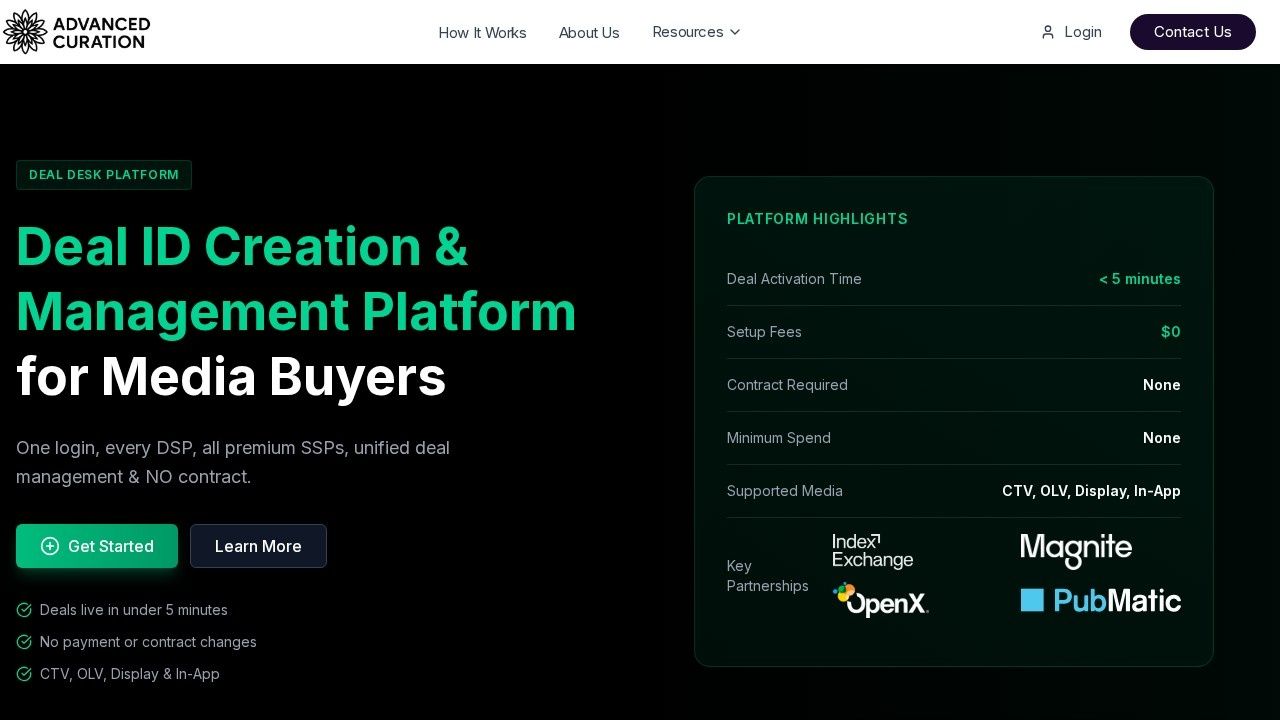
Advanced Curation is a deal desk platform: a self-serve environment for creating and managing Deal IDs across CTV, online video, display and in-app, spanning multiple DSPs and premium SSPs from a single login. Deals go live in under five minutes, with agentic deal creation and targeting by location, media type and DSP. There are no setup fees, no contracts and no minimum spend.
The strongest argument for it is the least glamorous one. Most buying teams lose real hours to logging into five platforms to build and troubleshoot the same deals, and they accept whatever margin-based pricing each SSP presents. Consolidating that into one interface with market-based pricing is unexciting and quietly valuable. The company publishes no case-study performance figures, so evaluate it on workflow and pricing rather than on claimed lift.
- Official Website: advancedcuration.com ↗
- Model: Self-serve deal desk across multiple DSPs and SSPs
- Channels: CTV, OLV, display, in-app
- Commercials: No setup fees, no contracts, no minimum spend
- Speed: Deals live in under five minutes
Splash Bay Media — CTV-Specific Curated PMPs

Where it fits: Programmatic teams, performance buyers and political advertisers who want curated CTV supply with a shopper-intent layer.
Splash Bay Media is a sell-side decisioning platform focused specifically on connected TV. It packages premium CTV inventory into private marketplaces built for performance, drawing on direct relationships with major CTV publishers and AVOD and FAST platforms, and layers a shopper-intent data graph covering 50 million+ monthly shoppers on top. Its Ichiro platform is the command center for the curation itself, and it will build custom packages around live sports or political flights.
The company reports 1,000+ curated PMPs, deal activation in under five minutes, and a 40% cost reduction for one CPG brand achieved through supply path optimization. The CTV specialization is the reason to consider it over a generalist curator: supply path optimization in television is a different problem from display, and vendors that treat CTV as one more channel tend to miss it.
- Official Website: splashbaymedia.com ↗
- Model: Sell-side decisioning and CTV curation via the Ichiro platform
- Inventory: 1,000+ curated CTV PMPs across major publishers, AVOD and FAST
- Data: Shopper-intent graph covering 50M+ monthly shoppers
- Specialties: Live sports and political CTV packages
What Experienced TV Buyers Optimize — and What They Ignore
Every platform on this list will lead a pitch with targeting. Almost none of the difference in outcomes comes from targeting. What follows is the part of the conversation that rarely makes it into a sales deck.
The audience targeting trap
The prevailing industry message is that you should layer third-party audience data onto every buy — Experian, TransUnion, credit and demographic attributes, seed audiences modeled off your best customers. The workflow is genuinely impressive: you hand over your customer file, the provider resolves it against a database of behavioral and credit attributes, finds the patterns, and builds a lookalike pool.
In practice, seasoned buyers use it sparingly. Every layer of audience targeting narrows the pool and raises the clearing price, and on television the incremental precision usually does not pay for the incremental CPM. It sounds like a step backwards, but the more experienced the buyer, the more likely they are to start broad, gather real delivery data, and optimize into what actually converted — rather than deciding in advance who the audience is and paying a premium to reach only them. Audience data has a place, particularly in regulated categories where lookalikes are restricted. It is a tool, not a strategy, and vendors that lead with it are often compensating for weaker optimization.
Optimization is the product
Setup is easy to sell and easy to copy. What separates platforms is what they do once impressions start delivering. When you evaluate a vendor, make them walk you through the levers, not the targeting menu:
- Network and app-level control. Can you see performance by network, app and channel, and can you actually exclude the ones that underdeliver — or only view them?
- Dayparting. Time-of-day and day-of-week performance, and the ability to shift budget accordingly.
- Frequency management. Household-level frequency caps, and reporting that shows where diminishing returns set in.
- Supply path. How many hops sit between your dollar and the publisher, and what each one takes.
- Creative rotation. Which spot, which length, which cut — and how quickly the system reallocates.
- Signals returned. What device, household and contextual data comes back that you can act on next flight.
Ask about competitive separation
This is the single most overlooked contract term in connected TV. An ad pod is the commercial break — several ads delivered back to back. When two or three advertisers from the same category land in the same pod, viewers stop processing them as individual brands and start processing them as a category: not three fintech companies, just “a finance ad.” Attention and recall degrade for everyone in the block.
Sophisticated advertisers write competitive separation into the contract, requiring that their creative never runs in the same pod as a named list of direct competitors. Most platforms can support it if you ask. Very few will offer it unprompted, because it constrains their inventory.
Premium versus remnant, honestly
Unusually low CPMs in television usually have a reason, and often the reason is remnant inventory — unsold supply released at a discount close to air. The word carries a stigma, because buyers hear “the impressions nobody else wanted.” That framing is mostly wrong: remnant is a pricing mechanism, not a quality tier, and much of it sits in perfectly good programming. It is a legitimate way to buy scale cheaply, and several platforms quietly build their cost advantage on it while marketing themselves on premium supply.
What matters is that you know the mix. Ask what percentage of delivery is guaranteed premium versus opportunistic, and ask to see it by flight. A blended CPM that looks excellent against a competitor’s rate card may simply be a different mix — and that is fine, as long as it is a decision you made rather than one that was made for you.
How to Measure Connected TV (Streaming Is Easy, Linear Is Not)
Streaming is device-addressable. Delivery resolves to an IP address, which resolves to a household, which can be matched to site visits and conversions. Measurement here is a solved problem in principle, and any platform on this list can show you a conversion path.
Linear is the hard part, and this is where you should apply the most scrutiny. Nearly every convergent TV vendor markets a proprietary attribution model that assigns cost-per-visit or cost-per-install to broadcast spots. Treat those numbers as directional. Large advertisers with meaningful linear budgets generally do not run their business off vendor-supplied linear attribution; they use media mix modeling to determine channel contribution and use the vendor’s model for in-flight decisions only.
Three requests worth making of any partner:
- Incrementality testing, not just attribution. Holdout geographies or matched-market tests answer the question attribution models only estimate.
- Overlap reporting. Most advertisers track digital channels in one system and CTV in another, then unknowingly pay twice to reach the same household. Ask the partner to analyze overlap with your existing digital delivery and to plan around it.
- Creative-level reporting. Creative analytics in television remain genuinely immature. If a vendor has a real answer here, it is a meaningful differentiator; if the answer is a spreadsheet of impressions by asset, price it accordingly.
10 Questions to Ask Any CTV Platform Before You Sign
- Do you transact linear TV as well as streaming, or streaming only?
- Which of your inventory comes from direct deals with networks or device manufacturers, and which is bid in the open market?
- What percentage of my delivery will be guaranteed premium versus opportunistic or remnant?
- Can I see and exclude performance at the network, app and channel level — not just view it?
- Will you contractually guarantee competitive separation within an ad pod?
- What are the specific optimization levers your team pulls in weeks two through six, and how often?
- How do you measure linear, and will you support a holdout or matched-market incrementality test?
- Can you produce an overlap report against my existing digital channel delivery?
- What creative-level reporting do I get, and at what granularity?
- What is your total take rate, including any supply path or curation fees, expressed as a percentage of working media?
Question ten is the one that separates a straightforward partner from a complicated one. Anyone who cannot answer it in a single number is telling you something.
How to Choose the Right CTV Platform
⚡ A Four-Question Shortcut
- Is linear on the plan? If yes, your shortlist is convergent partners such as Tatari, and comparing them on price against streaming-only platforms is comparing two different products.
- What is the monthly budget? Under $10K, the self-serve tier with low minimums is the practical entry point. In the $25K–$250K range, the performance platforms are built for that shape of spend. Above that, expect to negotiate direct deals and evaluate curation as a separate decision.
- Do you have an in-house programmatic team? If yes, keeping your DSP and adding a curation or decisioning layer usually beats switching platforms. If no, a platform with a managed-service layer will serve you better than raw tooling.
- Are you running in multiple countries? Global supply is a specialist problem and deserves a specialist partner rather than an extension of a domestic buy.
One final piece of advice that applies regardless of which name you pick: run two platforms in parallel for your first 60 to 90 days on connected TV, with a clean split and a shared measurement standard. The cost of the test is small relative to a year of committed spend, and platform-to-platform performance variance in CTV is still wide enough that the answer is rarely obvious from the pitch.
Frequently Asked Questions
What is the best connected TV advertising platform?
There isn’t a single best platform, and any list that names one is usually selling something. The category contains three different business models — self-serve performance platforms, convergent partners that transact linear as well as streaming, and curation layers that sit in front of your existing DSP — and the right answer depends on whether linear is on your plan, how much you spend, and whether you have a programmatic team in-house. Every platform in this guide has advertisers it serves well.
How much does connected TV advertising cost?
Entry points range from $500 on a self-serve platform like Vibe to six-figure monthly commitments with convergent partners. CTV CPMs typically fall in the $15–$45 range depending on inventory mix, targeting layers and how much of the delivery is guaranteed premium versus opportunistic. Beware of comparing blended CPMs across vendors without understanding the mix behind them.
What is the difference between CTV and linear TV advertising?
Connected TV is delivered over the internet to a streaming device or smart TV, so it is addressable by household and measurable against site visits and conversions. Linear TV is broadcast or cable, bought by program and daypart, and measured through panels and modeling rather than device-level data. Most platforms in this category sell streaming only; a smaller group transacts both.
Do I need audience targeting data for CTV campaigns?
Less often than vendors suggest. Each audience layer narrows the pool and raises the price, and on television the added precision frequently costs more than it returns. Experienced buyers usually begin broad, collect delivery data, and optimize into the segments that actually converted. Third-party data earns its keep in regulated categories and in specific niche targets, not as a default setting.
What is curation in CTV advertising?
Curation is the practice of shaping what your DSP is allowed to buy before the bid happens — packaging inventory into deal IDs, filtering low-quality or fraudulent supply pre-bid, layering data, and shortening the supply path between your budget and the publisher. It is the fastest-growing layer of the CTV stack because identical inventory can reach a buyer through several paths at several prices.
Who acquired Vibe and tvScientific?
Walmart acquired Vibe.co, announcing the deal in June 2026 and completing it on August 4, 2026; the platform now sits within Walmart Connect. Pinterest agreed to acquire tvScientific in December 2025, and the platform now operates as tvScientific by Pinterest. Both deals follow the same logic: companies with large intent and purchase datasets acquiring television distribution.
Leave a Reply